
The Bonaventure Cemetery in Savannah

Ah, Bonaventure Cemetery—the place where history, haunting beauty, and the occasional creepy vibe come together in one eerie, peaceful spot. This isn’t just any cemetery; it’s a Southern treasure with towering oaks, intricate headstones, and a dash of ghostly charm. If you’re into the spooky, the historical, or simply looking for a tranquil place to stroll (minus the ominous atmosphere), Bonaventure should be at the top of your Savannah list. Just don’t blame me if you hear footsteps behind you.

Long before Midnight In the Garden of Good and Evil made its debut, the Bonaventure Cemetery has been the final resting place for notable residents of Savannah.
Located on the outskirts of the city, Bonaventure Cemetery rests on 100 acres on a bluff overlooking the Wilmington River at the site of the former Evergreen Plantation.
The History of Bonaventure Cemetery In a Nutshell
In 1762, the site was settled by Claudia Catell Mullryne and her husband, Colonel John Mullryne. The colonel planted oaks trees every 15 feet on each side of the roadways within his 600-acre estate. Today, some of the large oaks that are draped with Spanish moss are around 250 years old.

In 1846, the property was purchased for a private cemetery. In 1907, the city bought the property making it a public cemetery.
Midnight in the Garden of Good and Evil
Bonaventure Cemetery might look familiar, thanks to Midnight in the Garden of Good and Evil. John Berendt’s bestselling book helped introduce millions of readers to Savannah’s eccentric characters, history, and slightly mysterious Southern atmosphere.
Bonaventure became closely associated with the book thanks in large part to the haunting Bird Girl statue photographed for its famous cover. The statue once stood in Bonaventure Cemetery, although it has since been moved and is no longer there.
Even without Bird Girl, it’s easy to see why Bonaventure and Midnight in the Garden of Good and Evil became so intertwined in people’s minds. Moss-covered oaks, elaborate monuments, old Savannah families, and stories in which fact and folklore aren’t always easy to separate are pretty much the ingredients for both.
Touring the Cemetery
It’s free to visit the cemetery and 1-hour long free tours are offered by the Bonaventure Historical Society on select weekends.
If you are staying in Savannah and did not bring your car with you, then you will have to arrange transportation to and from the cemetery. Or, you can do what I did and that is book a tour of Bonaventure Cemetery.
I booked with Dash Tours through GetYourGuide.com and am glad that I did. The owner, Timmy, provided round-trip transportation from the hotel where I stayed. Along the way, we heard stories about Savannah and Bonaventure, passed by a tiny home community for veterans, and learned about cemeteries and symbolism.

If you take more than one of the many tours offered in Savannah, you are likely to hear similar stories with a spin. It will make you wonder what really happened.
Timmy is a 6th-generation Savannahan and was able to point out facts from fiction. His degree in history is an asset for this profession.
Case-in-point. See that picture of Jesus at the gate above? That’s Alexander Lawton’s grave. Pictured below is the grave of his daughter, Corrine Elliott Lawton, and it to the left of Alexander’s grave. It appears that she has her back to Jesus. Some might tell you stories as to why she has turned her back on Christ.

Stories are told about how she died, such as that she committed suicide because she was not allowed to marry the man that she wanted. The reality is that she was sick for 10 days before (likely) dying from pneumonia in 1877. Timmy pointed out that she preceded her father in death (1896) and her memorial was created before her father’s.

You will likely notice a lot of “bathtub” or “cradle” graves around Bonaventure. What appears to be a bathtub extending from a headstone is actually a planter.

Speaking of cradles, there are a lot of small graves for infants at the cemetery. The infant mortality rate was high in the 1800s. In fact, in 1800, only 54% of babies lived to see their fifth birthday. Thankfully, by 1900 the survival rate improved to 83.5%.

Notice that small rock on top of the planter at the left-hand side? There is a Jewish tradition of leaving small rocks or pebbles at a gravesite. Two of the possible reasons as to why: 1) pebbles and rocks last longer than flowers, and 2) “putting stones on a grave keeps the soul down in this world.”

There are four people named Hugh Mercer buried in the plot pictured above. The original ancestor was a doctor from Aberdeen, Scotland, and was a general during the Revolutionary War for the Continental Army.

The cross at the foot of this grave indicates that the deceased fought for the Confederacy during the Civil War.

The relocated grave of John Mongin, owner of one of the first steamboats operating between Savannah, Charleston, and plantations on coastal waterways. He was originally interred at Daufauskie Island, South Carolina.

Everywhere you look, history abounds at the cemetery, along with beauty and life.
“Bonaventure is called a graveyard, a town of the dead, but the few graves are powerless in such a depth of life. The rippling of living waters, the song of birds, the joyous confidence of flowers, the calm, undisturbable grandeur of the oaks, mark this place of graves as one of the Lord’s most favored abodes of life and light.”
A Thousand Mile Walk to the Gulf, John Muir

Familiar with the idiom, “Saved by the bell?” The origin of the saying comes from the fact that years ago some people were unintentionally buried alive. Coffins that had been dug up had scratch marks on them from the undead trying to claw their way out.
To prevent that from happening, the allegedly deceased would be buried with a string connected to a bell outside the grave. Should he or she wake up and move, the bell would ring.
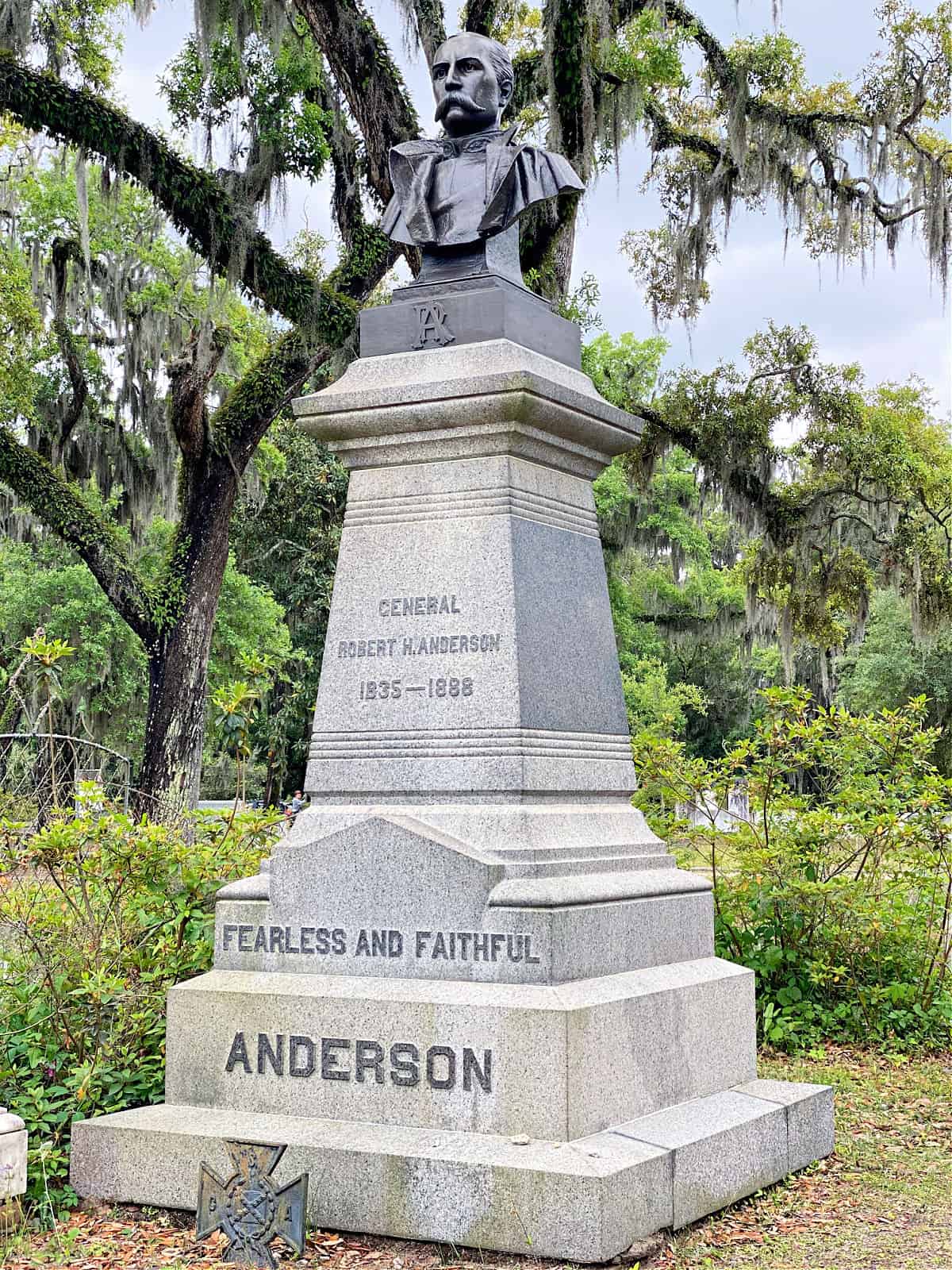
General Robert Anderson was a Confederate Brigadier General who fought on through the March to the Sea and the Carolinas Campaign. After the war, he served as Savannah’s chief of police from 1867 until his death.

Notable “Residents”
Bonaventure’s beauty goes far beyond its moss-draped trees and peaceful setting. It’s also where some of Savannah’s most fascinating stories rest. From the marble statue of a little girl whose memory still draws visitors, to the graves of poets and musicians whose work shaped generations, every path seems to lead you into another piece of history.
Gracie Watson
The grave of Gracie Watson is allegedly haunted by the ghost of the 6-year-old who died of pneumonia. It is a popular graveside destination for visitors to the cemetery.

Coins are left at the graveside and folklore has it that if you take any of the gifts left for Gracie, the statue will cry tears of blood.

Johnny Mercer
Another famous resident at Bonaventure is Johnny Mercer, the famed American lyricist, songwriter, and singer.

Johnny was born November 18, 1909, in Savannah and eventually made his way to New York where he eventually joined Paul Whiteman’s orchestra. He wrote lyrics for Broadway musicals and motion pictures and founded Captial Records in 1942.

Some of his more popular works include “Jeepers Creepers,” “Hooray for Hollywood,” “You Must Have Been a Beautiful Baby,” “Ac-cent-tchu-ate the Positive,” and “Moon River.”
Mercer died June 25, 1976, in Bel Air, California, and was buried in his family’s plot at Bonaventure.

Conrad Aiken
Another famous resident is the writer and poet Conrad Aiken.

Born in Savannah in 1889, he spent the first 11 years of his life at 228 Oglethorpe Street. He moved away after his father shot and killed his mother and then turned the gun on himself, committing suicide.
Aiken’s work would naturally be affected by the tragic loss of both of his parents. It is said that he was influenced by early psychoanalytic theory and was concerned largely with the human need for self-awareness and a sense of identity.

Conrad won the Pulitzer Prize for poetry in 1930 and he served as the poetry consultant to the Library of Congress (poet laureate) from 1950 to 1952.
He returned to Savannah in 1962 and lived at 230 Oglethorpe Street – the house next door to where he grew up, for the final 11 years of his life.

Symbolism at Cemeteries
Throughout the ages, memorials have been created to honor the deceased. Around the cemetery, you will no doubt see symbols that speak about the deceased. Here is a brief guide to some of the symbols you will see and what they represent:
- Arches – Gateway to Heaven
- Key – entrance to Heaven
- Lambs – innocence, purity
- Oak leaf – strength
- Obelisk – Eternal life, heaven, or rays of the sun shining down on the deceased forever
- Rose – motherhood
- Rosebud – purity; a youthful death
- Shoes – loss of a child
- Tree stump – a life cut short
- Urn – death of the flesh

Visiting Bonaventure
If Bonaventure Cemetery is on your Savannah list (and it should be!), here are a few tips to make your visit even better:
- Hours & Access – The gates are open daily from 8:00 AM to 5:00 PM, and admission is free. You’ll find parking near the visitor center, and if you’re the kind of traveler who loves stories, consider a guided tour—they add so much context to what you’re seeing.
- Best Time to Visit – Mornings and late afternoons are pure magic, with sunlight filtering through the Spanish moss. Spring brings bursts of azaleas and camellias, while fall adds rich color. If you can time your visit for one of those seasons, you’re in for a treat.
- Photography – Bonaventure is a photographer’s dream. The oak-lined lanes and statuary almost feel cinematic. Just remember—it’s still an active cemetery. Be respectful of services or visitors paying their respects, and avoid standing on graves for “the shot.”
- Etiquette – Think of Bonaventure as equal parts museum and sacred space. Stay on the paths, use quiet voices, and avoid touching or leaning on monuments. Comfortable shoes are a must—you’ll be walking quite a bit.
- Bug Spray – Savannah may be charming, but let’s be real—the mosquitos think it’s their city, too. In the 1800s, outbreaks of yellow fever claimed thousands of lives here, all thanks to those tiny pests. While modern medicine has solved that problem, the bugs are still around and ready to nibble. If you’re a natural bug magnet, pack the spray—it’s the easiest way to keep the focus on the beauty of Bonaventure instead of swatting your way through it.
Looking for a specific grave of someone interred at Bonaventure? Head over to Find A Grave and input their information.
Can You Visit Bonaventure Cemetery at Night?
While the cemetery is open to the public daily from 8:00 AM to 5:00 PM, visitors aren’t allowed to enter the cemetery on their own after the gates close.
However, that doesn’t mean you can’t experience Bonaventure after dark—or at least after regular visiting hours. The City of Savannah allows registered tour companies to offer approved after-hours tours between 5:00 PM and 8:00 PM. These tours must be arranged in advance with the city’s Cemeteries Department, so you’ll need to book with an authorized tour operator rather than simply showing up at the cemetery after closing.
Some private companies offer evening tours that lean into Bonaventure’s stories, folklore, and wonderfully eerie atmosphere. Depending on the time of year, an evening tour may give you a chance to see the cemetery as daylight fades and the moss-draped oaks take on an entirely different look.
Just don’t plan on a midnight stroll among the headstones. The City of Savannah does not permit cemetery activities between 8:00 PM and 6:00 AM. If seeing Bonaventure after regular hours is on your Savannah wish list, book an approved evening tour and let someone else worry about getting you through the locked gates.
Final Call
Visiting Bonaventure Cemetery is just one piece of the Savannah experience. Once you’ve wandered among the moss-draped oaks, don’t miss the chance to explore the city itself. I’ve rounded up some of the best places to eat in Savannah if you’re hungry, shared my tips about What to Drink in Savannah, and if you’re looking for a great place to stay, The DeSoto Savannah puts you right in the center of it all.
Have you wandered through Bonaventure Cemetery or are you adding it to your bucket list for your next Savannah trip? Tell me about your experience – or if you’re still too scared to visit! And hey, share this post with your friends—because everyone could use a little history and a hint of the supernatural in their travel plans.

I just love this post. I appreciate the brightness of your photos. Most photos of cemeteries are dark and taken to give a creepy vibes. Your post is a beautiful story of history and ancestory.
I love visiting graveyards on my travels. This looks like a cool one. Have you been to Pere Lachaise in Paris? And thanks for the guide to symbols – really interesting.
I have not been but would love to go!
I feel like I’ve read the book so many times, I know this place already. But you did a great job with this post, I’m definitely going to have to visit.
I really appriciate this post! I think it’s important to see and learn about the history of the place you’re visiting – even if it’s kind of dark – and cemetaries definitely fit into that.
This cemetery is really cool! Not just the look of it with Spanish moss dangling, but it is so rich in interesting history. We like visiting old cemetery during a trip, so I keep this in mind.